
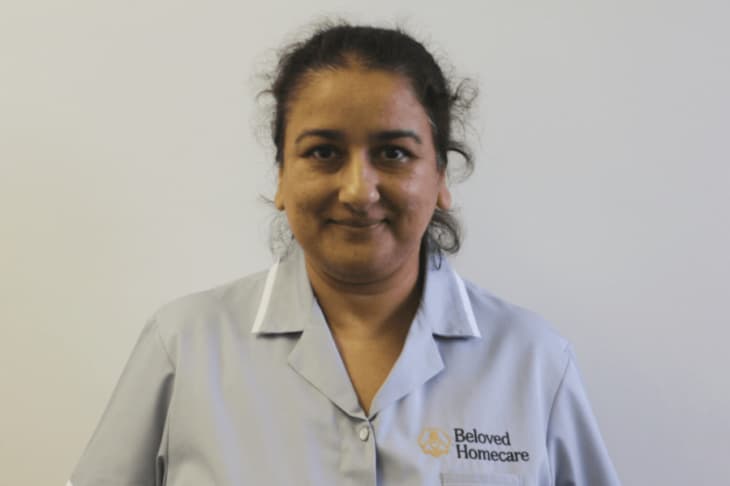
Abida talks to us about why she left the NHS after 20 years and what her motivation was to delivering hands-on care as a Healthcare Assistant.
Leaving the NHS after 20 years
“I was Head of Molecular Oncology Diagnostics at the Royal Infirmary in Manchester. I was doing that job for 14 years, however, I was in the NHS for a total of 20 years, and I loved it. Before working in the NHS, I was working in Cancer Research; trying to develop therapeutic strategies to treat cancer patients. The research I conducted was not to be used for just one hospital but was implemented across the North West, in 25 hospitals.”
After 20 years I felt like I needed to change my life and career. Instead of helping people, behind-the-scenes and working behind a desk, I wanted to take a hands-on approach and deliver care in person. Transitioning into becoming a Healthcare Assistant was easy for me due to my personal experiences in care. I looked after my Mum for 2 years and I loved it. I used the life skills I learned to obtain this new role and help deliver the level of care Beloved look for in their carers.
A typical day as a Healthcare Assistant
“I need to make sure I’m well-rested and prepared for the day ahead of me. Even though it is a very rewarding job it can also be physically and mentally demanding. When you’re driving to one client’s house to another it can be a bit tiring so it’s essential for me to time manage myself. Managing my time efficiently allows me to give myself some time to rest and plan my day. It allows you to get to the place you need to be, bright and perky and helps deliver a professional image of you and the company to the clients.”
“On a typical day, I’m usually on 3-4 different rounds a day. I do a mixture of personal care and social visits. Each visit typically lasts between 30 minutes to 2 hours. During my visits, I handle medication for the clients, follow the regulated procedures to administer it and track what has been given. I then report it the excellent support team we have in place which is Wendy and Emma. I not only keep them updated about medication but also alert them of any concerns I have regarding the client. They provide advice and guidance such as whether or not I need to alert a GP, district nurse, etc… which means you also need excellent communication and documentation skills to do this job.”
“You also need to be flexible and be able to adapt to a changing environment. It’s not like working in an office or a shop, you must be prepared to deal with people in need and not know what to expect when you arrive at their house. A lot of people just assume it’s a job where you just go to someone’s house, clean up a bit and then give them some medicine. The reality is it’s so much more than that.”
“At the moment this role suits my lifestyle as I do a lot outside of work. I want to give it my all when it comes to my job. I love the hands-on approach I get to take and I just love being around people and helping them.”

Showing our clients that we care
“Usually I tend to go visit the same clients. This means they are a part of my life and I am a part of theirs. As time progresses you build a level of trust. Before you know it, you know the personal aspects of each other’s lives. For example kids’ birthday plans and anniversary gift ideas.”
Our Final Thoughts
Abida is a great example of someone who joined our award-winning team with no hands-on experience in care and is now thriving in her role through a supportive development plan and training. Abida really stood out to us because of her bubbly personality, her commitment to helping others, and her willingness to learn. We’re proud to say Abida picked us over 3 other homecare providers when she joined and has now been a member of our team for over 2 years.
Interested in joining our award-winning team as a Healthcare Assistant?
Find out more about what we do as a homecare provider.